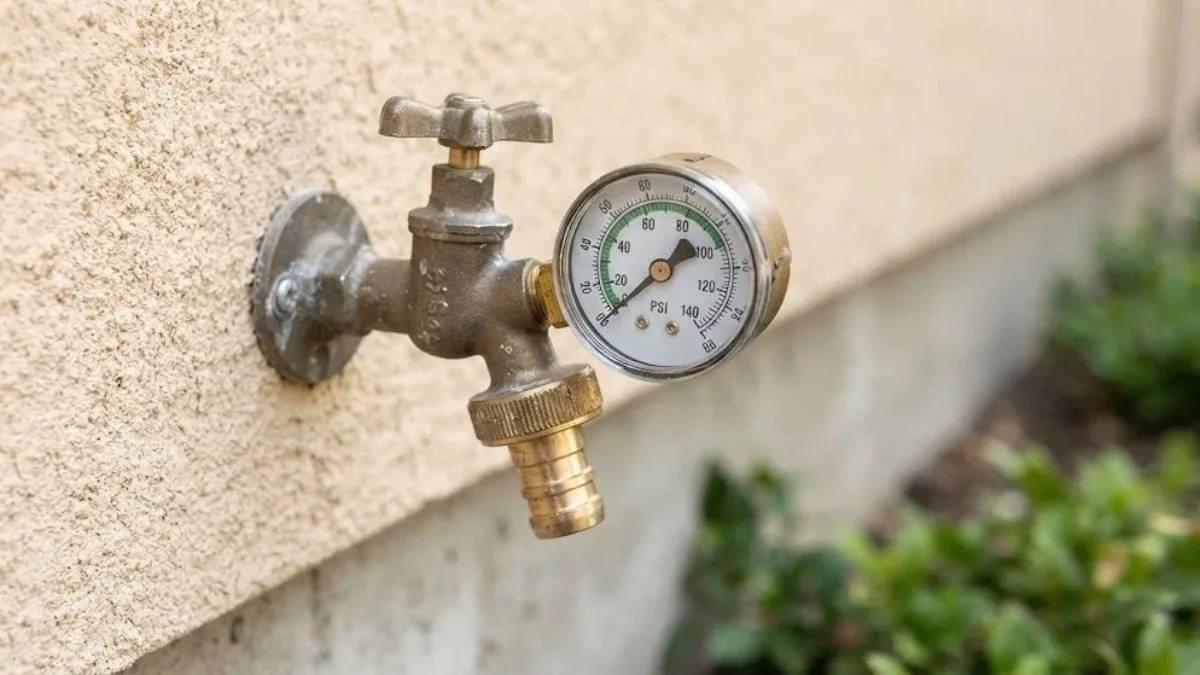
To test your home's water pressure, screw a pressure gauge onto an outdoor hose bib, turn the faucet on with no other water running, and read the dial. A reading of about 50 to 70 psi is comfortable for most homes. Anything above 80 psi calls for a regulator under the California Plumbing Code, and anything below about 40 psi usually feels weak in the shower.
The test takes a minute and costs less than a meal. It tells you whether your pipes, your fixtures, and your water heater are living under stress.
What your number means
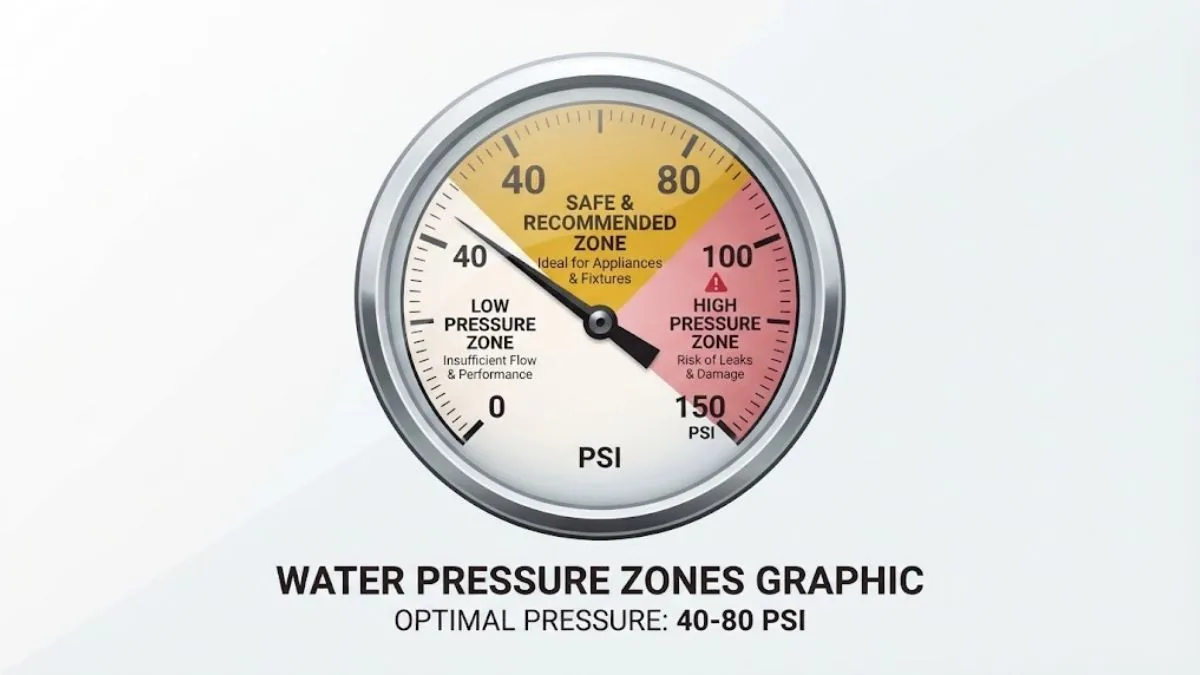
| Reading | What it means | What to do |
|---|---|---|
| Under 40 psi | Weak flow | Check valves, aerators, and the regulator |
| 40 to 50 psi | Acceptable but soft | Compare at several taps |
| 50 to 70 psi | Comfortable range | No action needed |
| 70 to 80 psi | Firm | Watch for water hammer |
| Above 80 psi | Too high | Install or replace a regulator |
Common causes of weak pressure
Check these in order
- 1A partly closed main shutoff or meter-side valve.
- 2Clogged aerators on faucets and showerheads, a common issue with hard water.
- 3A failing pressure regulator.
- 4Corroded or narrowed supply pipe.
- 5A leak on the service line between the meter and the house.
Start with the cheap items. Unscrew an aerator and look for white scale. If one fixture is weak and the others are fine, it is that fixture.
If every fixture is weak, look at the main valve and the regulator. If the meter spins with everything off, a leak may be stealing pressure, and our leak finding service finds it.
Why too much pressure is a problem
High pressure strains every joint and every appliance. It shortens the life of water heaters, washing machine hoses, and toilet fill valves. It also makes a small leak lose far more water. The usual fixes are a new regulator and, in a closed system, a thermal expansion tank on the water heater.
Signs of high pressure include banging pipes, a toilet that hisses after it fills, and a relief valve that drips. A reading above 80 psi confirms it. If the regulator is more than ten to fifteen years old, replacement is reasonable.
What the city reports
The City of Downey's Public Works says it targets a typical pressure of about 65 psi at its water yard. That is a system-level figure, and the pressure at your house depends on distance, elevation, and your own piping. A reading at your hose bib is the only way to know.
If your reading is high, our water service line repair page covers the line and valve at the entry, and the whole-house repiping page covers cases where old interior pipe has narrowed. We also test pressure for homeowners in the Pico Rivera area, where two separate water utilities serve different parts of the city.
Hammer arrestors and expansion tanks
| Part | What it does | When it is needed |
|---|---|---|
| Pressure regulator | Reduces incoming pressure | When pressure exceeds about 80 psi |
| Thermal expansion tank | Absorbs pressure rise as water heats | When the system is closed, with a regulator or check valve |
| Water hammer arrestor | Cushions sudden shutoffs | When pipes bang at fixtures or appliances |
| Isolation valves | Let you work on one section | Any renovation |
A closed system traps the extra volume of water as it heats, and the pressure rises. That is why a regulator often goes together with an expansion tank on the water heater. A tank with a relief valve that drips regularly is a hint. A plumber can check the air charge in the expansion tank with a gauge in a minute.
Replacing a regulator is usually a short job, but it should be done with the water off and the line relieved. Ask the plumber to set the pressure and show you the reading at the hose bib afterward.
What to tell a plumber about pressure
- 1Your reading at the hose bib, and the time of day.
- 2Whether it changes between morning and evening.
- 3Whether you hear banging or hissing.
- 4Whether the water heater relief valve has dripped.
- 5The age of the regulator, if you know it.
Pressure that is right for the system is quiet. Fixtures last longer, the water heater lasts longer, and a small leak stays small. It is among the cheapest changes you can make to a house.
Three readings and what we would do
| Reading at the hose bib | What it suggests | What we would do next |
|---|---|---|
| 34 psi | Low for the whole house | Check the main valve, regulator, and aerators, then look for a leak |
| 62 psi | Comfortable | Nothing, and note the date |
| 95 psi | Too high | Check the regulator, and add an expansion tank if needed |
The same house can give different readings at different times of day. Utility pressure often dips in the evening when many people use water, and rises overnight. A gauge with a drag needle records the highest reading while you are away, which is a good way to catch overnight spikes.
If you replace a regulator, set it to the middle of the comfortable range, around 60 psi, and re-check at the hose bib. A reading you can write on a sticky note next to the valve is a gift to the next person who works on the house.
In older homes with narrowed pipe, a high reading at the hose bib can still come with weak flow at a distant shower. The gauge measures pressure with no flow, and weak flow under demand points to restriction in the pipe, not the regulator.
If you rent and suspect a pressure problem, report it in writing with your gauge reading and the date. A reading is a fact, and it moves the conversation from "my water feels weird" to "the pressure at the hose bib is 96 psi." A landlord or a plumber can act on the second statement. Owners can use the same reading to decide whether a regulator belongs on this year's repair list.
The 80 psi limit comes from the California Plumbing Code, which is built on the Uniform Plumbing Code (UPC). The code treats pressure above that figure as a reason to install a regulator, so a reading over 80 psi is not a matter of taste. It is a point at which the code expects a fix.
Common questions
Many plumbers aim for roughly 50 to 70 psi at the hose bib. The California Plumbing Code expects a pressure regulator above 80 psi. Below about 40 psi, showers and appliances may feel weak.
Hardware stores sell a simple gauge that screws onto a hose bib. Close all other water use, attach it, open the faucet, and read the dial.
A bell-shaped valve on the main line, usually near the shutoff, that reduces incoming pressure to a safe level. They wear out, and a failed one is a common cause of high pressure.
A banging noise when a valve shuts quickly, caused by a pressure surge. It can be a sign of high pressure or of missing air chambers. Persistent hammer can loosen fittings.