The meter is moving and nothing is running
Most hidden leaks announce themselves through the water bill or the meter, long before a stain appears. If the numbers rose and nobody changed their habits, or the meter dial keeps turning with every tap shut, water is going somewhere. The question is where, and the answer decides what kind of repair you need.
A leak inside a wall, under a floor, or in the yard does not leave much of a trail. You can narrow it down yourself in about half an hour, and the result will tell the plumber where to start.
A 30-minute meter test
- 1Turn off every faucet, appliance, and ice maker. Make sure no one flushes a toilet.
- 2Find the meter box, usually near the curb at the front of the property. Lift the lid and look for the small low-flow dial or triangle that spins when water moves.
- 3If it spins, or if the reading changes after 30 minutes, water is leaving the system.
- 4Next, close the main shutoff valve at the house and check the meter again.
- 5If it still moves, the leak is on the service line between the meter and the house. If it stops, the leak is inside the house.
- 6Leave the utility's own valve at the meter alone. It belongs to the city.
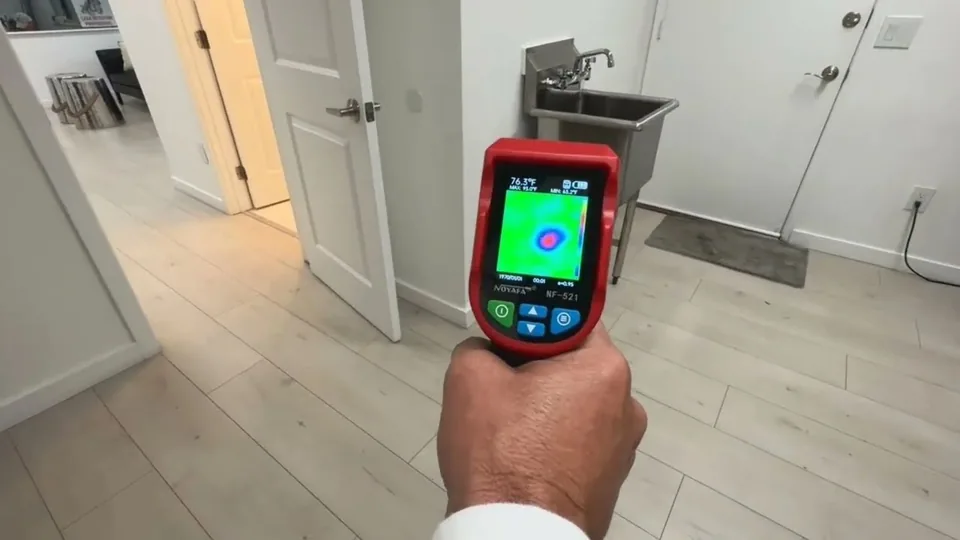
Leak detection in Downey, CA is the work of locating a hidden water leak with listening equipment, thermal imaging, and pressure testing so the repair opens as little as possible. It answers one question, where, and then hands you an accurate estimate for the fix.
Methods, and when each one fits
| Method | What it finds | Best for |
|---|---|---|
| Meter and pressure test | Whether water is leaving, and which section of pipe | The first step on nearly every call |
| Acoustic listening | The sound of water escaping a pressurized pipe | Buried lines, slab leaks, walls |
| Thermal imaging | Temperature differences from hot-water leaks or damp materials | Hot lines, radiant paths, ceilings |
| Camera inspection | Cracks and breaks inside drain lines | Drain and sewer leaks |
| Dye and moisture checks | Fixture-level leaks and damp materials | Toilets, tubs, around shower valves |
Water bill climbing for no reason?
Run the meter test, then call. Tell us what it showed.
What the local numbers tell us
The City of Downey Water Division supplies the city and bills each address by meter, so the meter is the first witness. The city's Utilities Division also says it handles leak investigations and flow and pressure testing for customers, so ask it about the meter side before anyone digs.
It also targets pressure of about 65 psi at the water yard. Higher pressure pushes more water through a pinhole, so a leak in a house at the high end of the range loses more each day than the same leak at a lower pressure.
Roughly 13,400 of Downey's 36,000 homes date to the 1950s, with more from the 1940s and 1960s. Homes of those ages have had decades of use, which makes supply-line corrosion, failed valve stems, and aging fittings the ordinary suspects. A leak is more likely to be wear than a freak event, and that is useful to know when you weigh a spot repair against a larger plan.
Hard water adds scale inside older pipes and around valves. Scale narrows the pipe and, over years, accelerates pitting at joints. We note it when we see it, because it affects what we recommend afterward.
What leak detection does not do
Detection finds the leak. It does not repair it. A repair is a separate job, and depending on what the tracing shows, it may be a small patch, a replaced section, or something larger such as water line repair and replacement or a full repipe.
We also will not guess. If the equipment cannot isolate a leak with confidence, we say so and suggest the next step instead of opening a wall on a hunch.
After a repair, the California Plumbing Code, built on the Uniform Plumbing Code (UPC), expects the water piping to be tested and proved tight at working pressure. We run that test before anything is closed up, so you are not trusting a patch you cannot see.
What happens on the visit
Interview
When the problem started, what you have seen, and what the meter did.
Isolate
Pressure testing narrows the leak to a section.
Pinpoint
Listening or thermal tools confirm the spot.
Report
You get the location, the cause, and a repair price.
What affects the price of finding a leak
Insurance note: many homeowner policies cover the cost of tearing out to reach a sudden leak, but not repairs for wear or slow seepage. Ask your insurer before work begins, and photograph any damage first.
Leak detection questions from Downey
Run the meter test in the box above. If the meter moves with every fixture off, water is leaving somewhere. Closing the main valve at the house tells you whether the loss is inside the house or on the line between the meter and the house. Then call, and we will trace the exact spot.
Acoustic listening gear picks up the sound of water escaping a pressurized pipe. Thermal imaging shows temperature differences from hot-water leaks or damp materials. Pressure testing isolates which section of pipe is losing water. We use the least invasive method that answers the question.
The purpose is to avoid that. Tracing narrows the leak to a small area, so if a repair needs access, it is a small opening instead of a large one. We tell you where we plan to cut before we cut.
Usually not. A running toilet is a flapper or fill valve problem, and a dye test confirms it. Put a few drops of food coloring in the tank and wait. If color shows in the bowl without flushing, the flapper is leaking. A toilet repair and installation usually fixes it.
Often, yes. A slow leak that adds a few dollars a month may not be worth chasing right away. A leak that runs day and night is different, because the bill grows and the wet material around it keeps taking damage. We can tell you which category you are in after the meter test.
Yes, with acoustic and thermal methods. The repair is its own subject, covered on our slab leak detection and repair page.
Yes, the same 24/7 line covers Downey and its neighbors. ZIP codes 90240, 90241, and 90242 are all inside the Downey service area.
If the leak turns out to be from a failing tank, our tank heater repair service takes it from there. For pipes that have split outright, see burst pipe repair, and we run leak calls in Santa Fe Springs as well.
Downey is in Los Angeles County, and the City of Downey Water Division reads meters on a two-month cycle, which lets a slow leak run a long time before a bill shows it. Homeowners from the Columbia Memorial Space Center to the Firestone Boulevard blocks near Stonewood Center can run the one-hour meter test and call the city or us with the result.
Losing water somewhere?
Call the Downey line. We will help you narrow it down on the phone first.
☎ Call (562) 488-9614