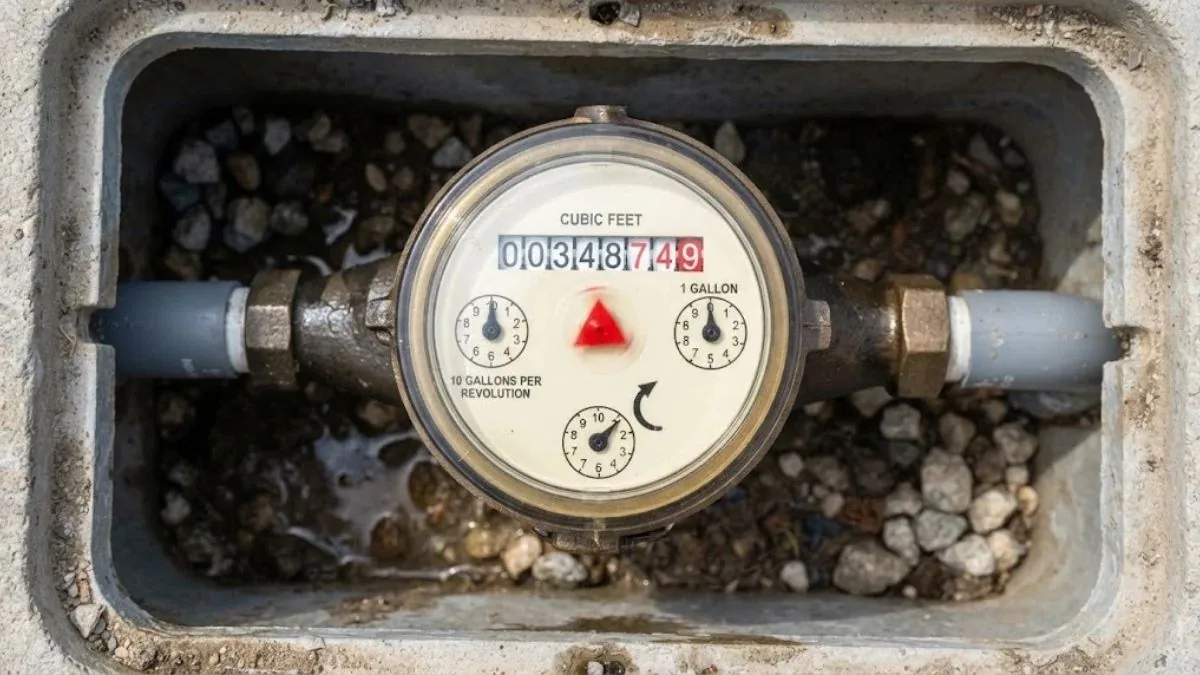
To read your water meter, lift the meter box lid, find the register, and read the numbers like an odometer, noting the unit marked on the face. To check for a leak, record the reading, use no water for an hour, then read it again. If the number changed, water is leaving your system, and the size of the change tells you how fast.
The meter is the most honest witness in the house. A bill tells you what you used last month. The meter tells you what you are using right now.
Two common meter faces
| Meter type | How it looks | How to read it |
|---|---|---|
| Straight reading | A row of digits like a car odometer | Read the digits left to right, including any red or fractional digits |
| Dial or sweep hand | Round dials with pointers, plus a sweep hand | Read the digit dials, then watch the sweep hand for small flow |
| Low-flow indicator | A small triangle, star, or dial | Watch it for any movement when all water is off |
A little arithmetic
If your meter reads in cubic feet, multiply the change by 7.48 to get gallons. Here is an illustration with made-up numbers, not a measurement. Suppose the reading goes up by 0.3 cubic feet in one hour with everything off.
That is about 2.2 gallons an hour, or roughly 54 gallons a day. If the meter reads in gallons already, no conversion is needed.
A small number does not mean a small problem. A slow leak that runs all month adds up, and the wet material around it can be damaged long before the bill shows it.
Prepare
Turn off every faucet and appliance, including the icemaker.
Record
Write down the reading and the time.
Wait
Use no water for an hour.
Compare
Read again. A change means water is leaving.
Inside the house or underground
A two-step way to narrow it down
- 1Close the main shutoff valve at the house and read the meter again.
- 2If the meter still moves, the leak is on the line between the meter and the house.
- 3If it stops, the leak is inside the house.
- 4Check toilets with food coloring in the tank.
- 5Call a plumber with what you found. It saves time.
What the city does, and what you can do
The City of Downey's Utilities Division reads about 22,500 meters every two months and says it provides leak investigations and flow and pressure testing for customers. That is a useful first call if the leak seems to be on the meter side. If the evidence points to your own pipe, a plumber can trace it with listening equipment and thermal imaging, as our leak tracing page explains.
The line between the meter and the house is generally the owner's, and our service line repair page covers repairing it. In Norwalk, where Golden State Water serves the city, the process is similar, and our the Norwalk area page explains the local details.
Things that move the meter without being a leak
| Source | Why the meter moves | How to rule it out |
|---|---|---|
| Icemaker | It refills automatically | Turn off its supply valve for the test |
| Water softener | It regenerates on a schedule | Run the test at a different time |
| Irrigation timers | Zones run on schedule | Switch them to off |
| Toilet | A slow flapper leak refills the tank | Dye test |
| Hot water recirculating pump | May trigger small flows | Check manufacturer notes |
Run through those items first, then repeat the test. If the meter still moves, the leak is real, and the one-valve test tells you which side. An outdoor leak is easier to find in the early morning, when the ground is quiet, and wet or unusually green soil along the line is a clue.
Keep a simple log. Write down the date, the reading, and the result. A series of readings over a week shows a trend and helps whoever comes to find the leak.
Reading your bill alongside the meter
- 1Find the billing unit, often CCF or HCF, equal to 100 cubic feet.
- 2Compare this period's use with the same period last year.
- 3Look for a rise that does not match any change in your household.
- 4Check whether the meter is read every month or every two months.
- 5Call your utility if the bill and the meter disagree.
The goal is not to turn you into a plumber. It is to bring a clear observation to the people who can fix the problem, so that a half-hour of your time saves hours of theirs.
Reading a month of numbers
Suppose you record a meter reading of 12,345.0 cubic feet at 9 p.m. with everything off, and 12,345.4 at 10 p.m. The difference is 0.4 cubic feet, which is about 3 gallons in an hour, or roughly 72 gallons a day. The numbers are illustrative, not a measurement, but they show how a small change adds up over a month to thousands of gallons.
Repeat the test the next morning before anyone wakes up. If the number is the same, the leak runs steadily, which suggests a pipe or a fitting. If it changes, a toilet or a timer is a suspect. Write both results down and hand them to whoever you call.
What to include when you call
- 1The meter readings and the times.
- 2Whether the low-flow indicator moved.
- 3The result of the main-valve test.
- 4Any wet spots you have seen.
- 5The age of the house and the pipe, if you know it.
Finally, remember that the meter is a tool for comparison. Record your normal overnight reading once, when you know nothing is leaking, and keep it in your phone. Next time you suspect a problem, you have a baseline to compare against. People who do this catch small leaks in days instead of billing cycles, and a short call to the right person usually settles it.
The Uniform Plumbing Code (UPC), which California's plumbing code is built on, expects a shutoff valve where the water supply enters a building. That is the valve you use for the second step of the test above, and if yours is missing or stuck, fixing it is worth doing before you need it.
Common questions
Many California utilities bill in hundred cubic feet, often written CCF or HCF. One of those units is 100 cubic feet, which is about 748 gallons. Your meter or bill states the unit.
A low-flow indicator. It spins or flashes when even a small amount of water passes. If it moves while everything is off, water is leaving.
Possibly. A running toilet, a dripping tap, an icemaker, or a softener regenerating can all move it. Check those first, then run the one-hour test.
Some do. The City of Downey's Utilities Division says it provides leak investigations and flow and pressure testing for customers. Ask your own utility what it offers before you pay for a search.
Meter moving with everything off?
Call the Downey line and tell us what you found.
☎ Call (562) 488-9614