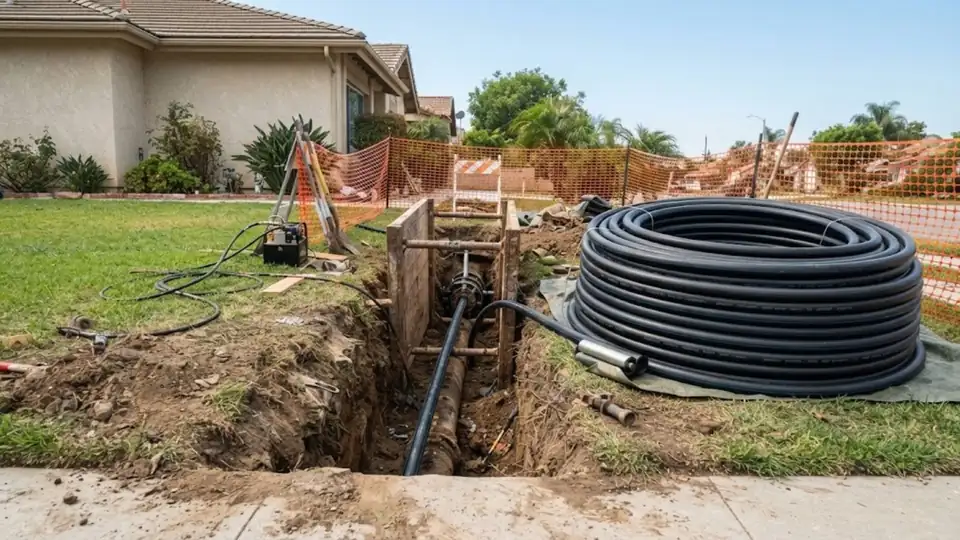
When repair stops making sense
Sewer line replacement in Downey, CA means installing a new pipe from the house to the public main connection, usually because the old one has failed over much of its length. It is a bigger job than a repair, so the first task is to confirm that nothing smaller will do.
Four findings on the camera push the answer toward replacement. The pipe has collapsed or been crushed. Cracks and separations run along most of the line.
Roots have entered at many joints, not just one. Or a previous repair has failed more than once. If none of those are present, a smaller option is likely to be enough.
Questions to answer before replacing
- 1Has a camera inspection recorded the whole length, including where the lateral meets the main?
- 2Is the damage concentrated in one spot, or spread along the run?
- 3Has the line been repaired before, and where?
- 4Do you plan to sell or remodel soon, which could change the timing?
- 5Does the line cross under a driveway, patio, or tree that affects the method?
Pipe bursting, open trench, and what each means
Pipe bursting
- A new plastic pipe pulled through the old line
- Two small pits at the ends instead of a full trench
- Less disturbance to landscaping and hardscape
- Depends on the old pipe being burstable
Open trench
- The full length is excavated and new pipe laid
- Allows regrading to fix a sag
- Useful when the old line has collapsed
- Requires restoration of everything dug up
Trenchless lining is a repair method rather than a replacement, and it is covered on our spot sewer repair page. If the pipe is only dirty and not damaged, start with water jetting.
Camera showed major damage?
Call and we will review the findings with you, or inspect the line fresh.
The steps that happen before the first shovel
| Step | Why it matters | Who handles it |
|---|---|---|
| Utility marking (811) | Locates gas, electric, and other buried lines before digging | The contractor calls, and marks are required before work |
| Permit | Allows the city to inspect the new pipe | The contractor, unless you agree otherwise |
| Locate and depth | Sets the route, depth, and slope | The plumber, with the camera and locator |
| Inspection | The city checks slope, bedding, and connections | The city inspector, arranged by the contractor |
| Final camera pass | Records the new line for your files | The plumber |
How local housing ages the pipe
Census-based counts put about 1,460 Downey homes before 1940 and about 3,030 more in the 1940s, with roughly 13,400 from the 1950s. Those older groups are where the longest-serving laterals are most likely to be. In ZIP 90242, the 1940s and 1950s dominate, while ZIP 90240 is about half 1950s housing.
Newer construction is a different case. About 2,700 homes date to 2000 or later, and their plastic laterals are far from the end of their life. A sewer problem in one of those homes is more likely a localized defect, which makes a repair the better first question.
For a household with an older house, the lesson is simple. Know the condition of the line before an emergency forces the decision. A planned replacement is easier on the budget and the yard than one done in the middle of a backup.
How a replacement unfolds
Inspect and plan
Full-length camera, locator, and a written scope.
Permit and marking
Permits and the 811 call are completed.
Replace
Old pipe removed or burst, new pipe installed to the correct slope.
Inspect and restore
The city inspects, then the surface is restored.
What shapes a replacement estimate
Insurance note: most standard homeowner policies exclude replacement of a sewer line that failed from age. A service line endorsement, if you have one, may help. Read your declarations page before you schedule.
Sewer line replacement questions from Downey
A repair is enough when the camera shows one or two bad spots and the rest of the pipe is sound. Replacement is the better call when damage runs through most of the line, when the pipe has collapsed or been crushed, or when repairs keep failing. We show you the footage so the decision rests on what is in the ground.
Pipe bursting pulls a new plastic pipe through the old one, breaking the old pipe outward as it goes. It needs two small pits instead of a full trench. Open trench replacement digs the full length and lays new pipe. Which one is available depends on the old pipe, its depth, and what lies above it.
Yes, in most cases. Sewer work normally requires a permit and an inspection from the city. The contractor should pull it and arrange the inspection, and a utility marking call to 811 is required before any digging.
Many residential replacements are finished in a few days once permits and utility marking are done, but the timeline depends on length, depth, access, and weather. We give you a realistic schedule with the written price.
Pipe bursting disturbs far less than a trench, and when the old pipe allows it, we prefer it. When trench work is needed, we describe what will be dug, how deep, and what will be restored, in writing.
It depends on length, depth, method, access, and surface restoration. We do not quote by phone for this kind of work because the camera and locate decide the price. After the inspection, you get a written number.
We also handle replacement work for homeowners in Pico Rivera, CA, and the same camera-first rule applies there. If a backup is happening now, the emergency steps on our drain clearing page apply.
Replacing a lateral in Downey, Los Angeles County, means working around driveways, mature trees, and utilities, and the City of Downey permit process applies. Homeowners anywhere from Wilderness Park to the Downey Theatre can ask us to map the run from the cleanout to the street first, which decides between pipe bursting and a trench.
Is your sewer line failing?
Call the Downey line. We will look before we recommend digging.
☎ Call (562) 488-9614