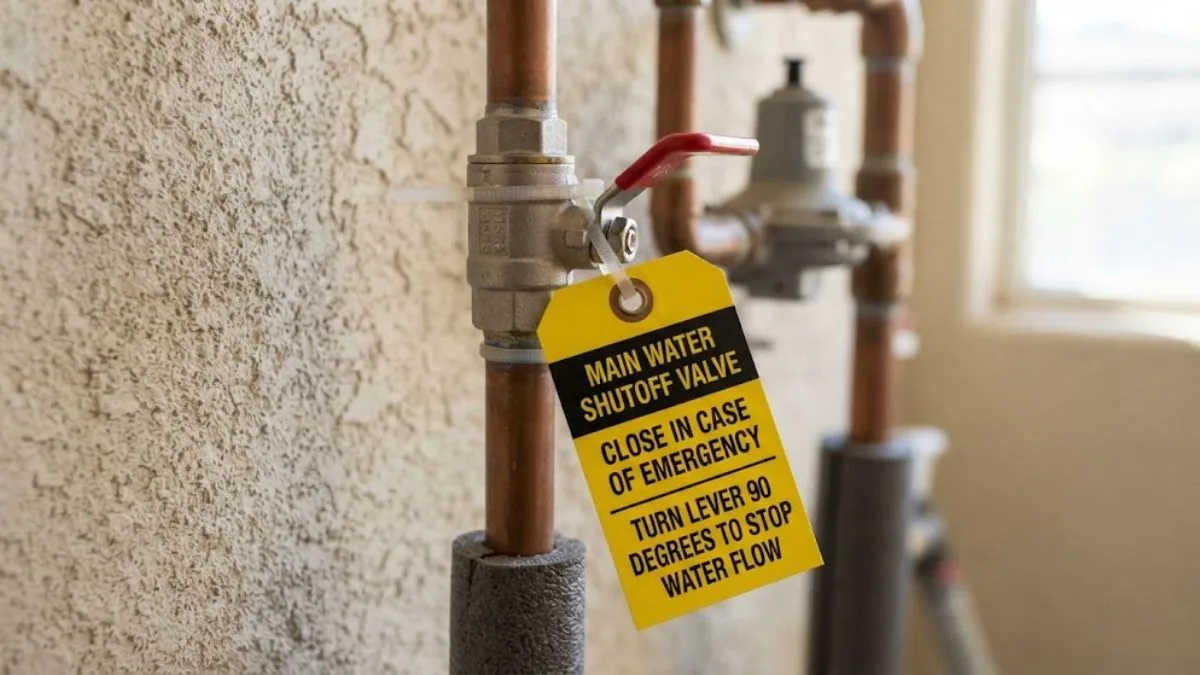
Your main water shutoff valve is usually on the front wall of the house, near the hose bib, or in the garage where the supply line comes in. It is a round wheel or a lever on the pipe, and you turn a wheel clockwise or a lever a quarter turn to stop all water into the house. Finding it before an emergency is one of the cheapest bits of preparation a homeowner can do.
When a pipe splits, the minutes before the water is off decide how much of the house gets wet. People who know where the valve is shut off the flow in seconds. People who do not spend those minutes searching.
The usual places for the valve
| Place | What to look for | Notes |
|---|---|---|
| Front of the house | A pipe rising from the ground near the hose bib | Common on slab homes |
| Garage wall | A pipe entering near the water heater | Often a wheel handle |
| Side of the house | A pipe coming out of the wall or ground | Check behind shrubs |
| Utility closet or basement area | Near the water heater or laundry | Less common here |
| By the curb, in a box | The utility's meter and valve | Not yours to operate |
If you cannot find it, trace the line. Follow the water pipe from the hose bib or the water heater back toward the wall where it enters the house. The main valve sits on that line before it branches. The meter box near the curb is a separate item, and the valve inside it belongs to the utility.
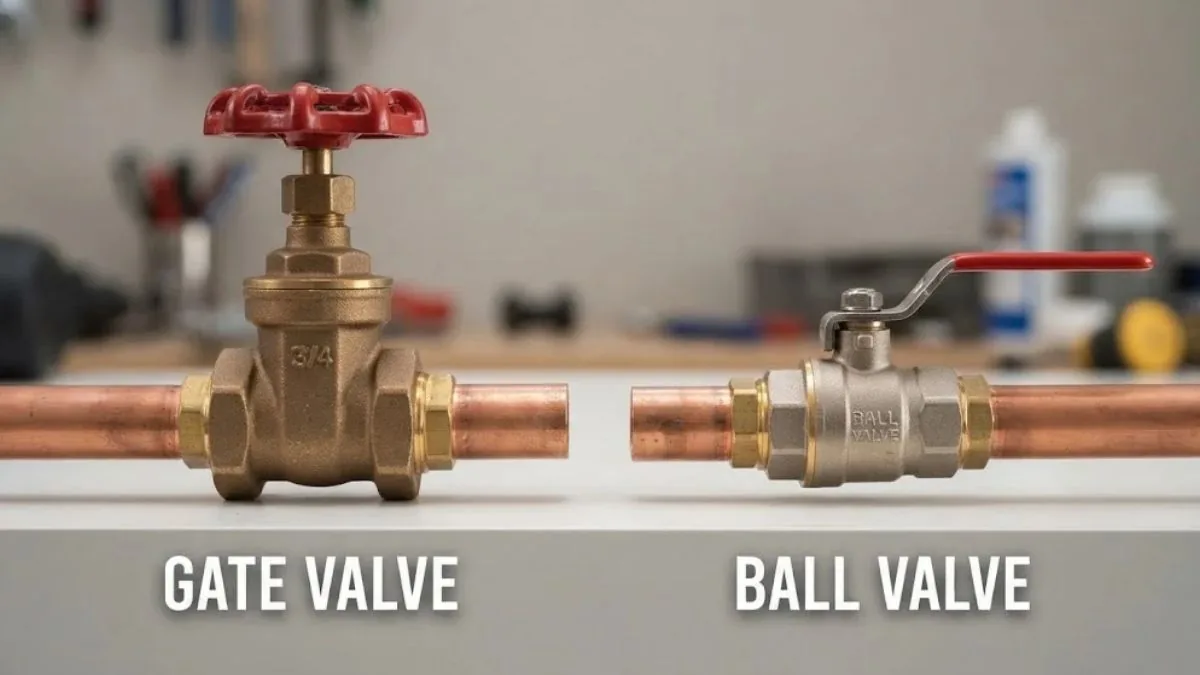
Gate valve or ball valve
| Type | Handle | How it fails |
|---|---|---|
| Gate valve | Round wheel you turn several times | Can seize or leak at the stem, and the gate can break loose |
| Ball valve | Lever that turns a quarter turn | More reliable and quick to operate |
Many older homes have gate valves. They work for years and then stop working the day you need them. Replacing a gate valve with a ball valve is a small job that pays for itself the first time you need to shut the water off in a hurry. Our burst line repair page explains the first minutes of an emergency.
A four-step routine you can practice
Find it
Locate the valve and clear anything in front of it.
Close it
Wheel clockwise until it stops, or lever a quarter turn.
Check it
Open a faucet. Water should slow to a trickle and stop.
Reopen it
Turn it back on slowly, then open a faucet to bleed air.
What to do if you cannot close the valve
- 1Do not use tools to force a seized valve. It can snap.
- 2Look for a second shutoff at the fixture that is leaking, such as the valve under a sink.
- 3Turn off the water heater if the leak is on the hot side.
- 4Call for help and describe what you see.
- 5If water is rising fast, move belongings and photograph the damage.
The small ones under sinks and behind toilets
Every sink and toilet should have its own shutoff, usually a small oval or round handle on a supply line. The California Plumbing Code, built on the Uniform Plumbing Code (UPC), expects an accessible shutoff at each fixture. These valves let you stop one leak without losing water to the whole house.
They also seize when they are never turned. Try each one gently once a year. If a handle will not move, or if it weeps water when turned, replace the valve before you need it, not during a leak.
What local conditions mean for your valve
The City of Downey Water Division targets about 65 psi at its water yard, and pressure at a house can be higher. At that pressure, a split supply line moves a lot of water quickly, which is why the shutoff matters. Its Utilities Division also reads about 22,500 meters every two months, so a leak that runs between readings can add up before anyone notices.
Census-based counts show roughly 13,400 Downey homes were built in the 1950s. Original shutoff valves in homes that old are often gate valves that have not been turned in decades. If you own one of those homes, testing the valve this weekend is time well spent.
If you are in a rental, tell your landlord where the valve is, or ask them. Our South Gate page covers renters and older homes in more detail.
Why people cannot shut the water off in time
| Mistake | What happens | Better habit |
|---|---|---|
| Storing boxes in front of the valve | You lose precious seconds clearing a path | Keep a clear 3-foot area |
| Never testing the valve | It seizes, and the handle spins or snaps | Turn it once a year |
| Closing the utility's valve at the meter | You may damage it, and it is not yours to operate | Use your own valve |
| Painting over the handle | Paint glues the stem and hides the handle | Scrape and label it |
| Not telling the household | Only one person knows where it is | Show everyone, including older children |
A tag on the valve helps. A simple paper or plastic tag that says MAIN WATER, with an arrow showing which way to close, takes thirty seconds to make and removes guesswork at the worst moment. Take a photo of the valve and keep it in your phone, in case you are away when someone else needs it.
If the valve will not close fully or drips at the stem, replace it before an emergency, and have the line behind it checked, since water line replacement covers the pipe that feeds it. Teach the routine to everyone who lives in the house. A teenager who knows how to close the valve can save a house when you are not home. A tenant who knows where it is can limit damage before the landlord arrives.
A short vacation checklist
- 1Close the main shutoff before a long trip.
- 2Turn the water heater to its vacation setting or off, following the label.
- 3Open a faucet at the lowest point to drain pressure, then close it.
- 4Ask a neighbor to check the house if you are gone for weeks.
- 5Restore water slowly when you return and check under sinks.
None of this costs much. The valve is already in your house. The only investment is knowing where it is and keeping it working, and that is the difference between a mop-up and a remodel when something fails.
Common questions
Clockwise to close, the same as a faucet, if it has a round wheel handle. A lever handle closes with a quarter turn so that it sits across the pipe. If neither moves, stop forcing it and call a plumber, because a stuck valve can break.
No. The valve at the meter belongs to the water utility. Your shutoff is the one on your side, between the meter and the house. Leave the utility's valve alone unless the utility tells you to use it.
Once a year is plenty. Turn it off and on again, and check that water stops at the faucets. A valve that is never used tends to seize.
It is a cheap precaution, especially for a long trip. Closing the main means a failed hose or fitting cannot flood the house while you are away. Turn off the water heater first if you drain the lines.
Water running where it should not?
Call the 24/7 line and we will walk you through the shutoff.
☎ Call (562) 488-9614