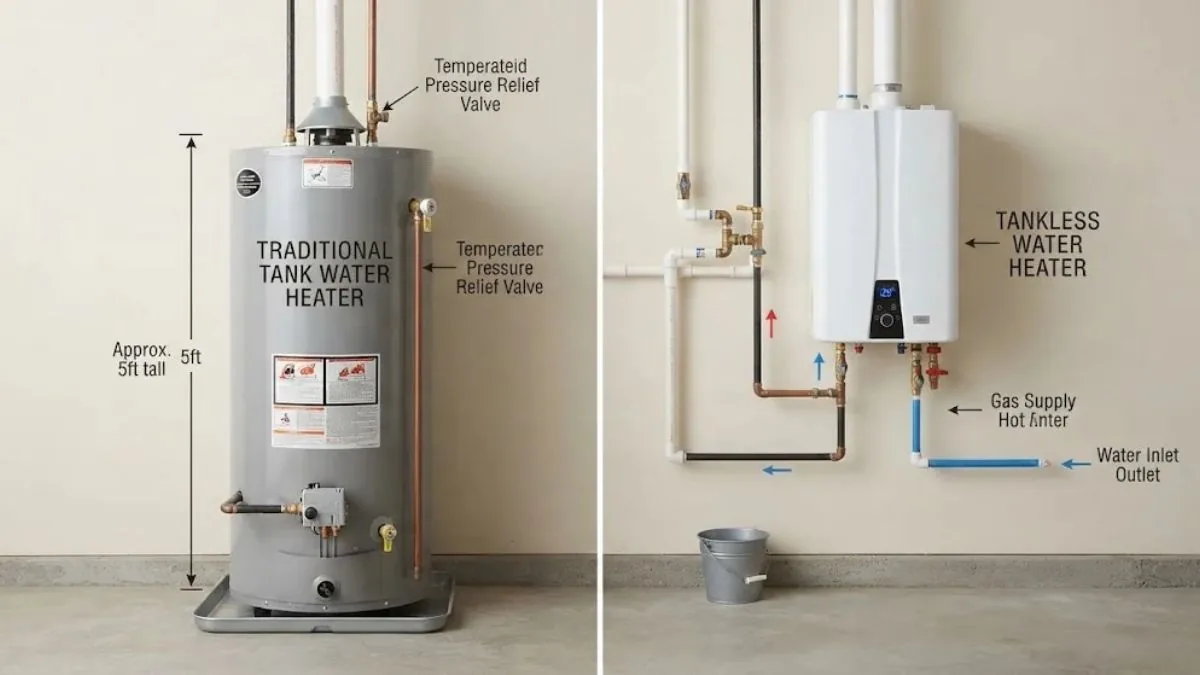
For most Southern California homes, a standard tank water heater is the lower-cost choice up front, and a tankless unit is the better choice if you want endless hot water, have the gas line and venting for it, and will descale it every year. A heat pump tank is the efficient electric option for homes with space and open air. The right pick depends on your household, your fuel, and your closet, not on a single winner.
Below are the questions that decide it, in the order a plumber would ask them. Answer them honestly and the choice usually makes itself.
Tank, tankless, and heat pump
| Factor | Standard tank | Tankless | Heat pump tank |
|---|---|---|---|
| Upfront cost | Lowest | Higher | Highest of the three |
| Running cost | Moderate | Lower for light use | Lowest |
| Typical life | About 8 to 12 years | About 20 with care | Often 10 to 15 |
| Space | Floor space | Wall mount, small | Floor space and air |
| Hot water supply | Limited by tank | Endless, up to flow limit | Limited by tank |
| Needs upgrades | Rarely | Gas line and venting | Drain and clearance |
Work through these in order
Fuel
Gas or electric? Switching fuels adds scope.
Use
How many people, and how many showers at once?
Space
Closet, garage, or wall? Venting and clearance matter.
Water
Hard water means yearly descaling for tankless.
A family that runs two showers and a dishwasher together will outgrow a small tank. A couple that uses little hot water may find a tankless premium hard to recover. Households with limited floor space benefit from a wall-mounted tankless unit, but only if the gas line can feed it. Our tank replacement page covers sizing for a tank.
Why it matters for the choice
Hard water leaves scale in the heat exchanger of a tankless unit, which cuts flow and triggers error codes. Our tankless descaling page explains the yearly flush. A tank collects sediment too, and a yearly flush helps it as well.
Official figures nearby make the point. Golden State Water reported an average of about 18 grains per gallon in Norwalk for 2025, and the City of South Gate's 2021 report averages about 13. Downey's water is hard as well, so whichever unit you choose, plan for maintenance. A softener reduces how often descaling is needed.
What a tankless upgrade can require
Tankless units use more gas at once than a tank does, so the gas line and the meter must keep up. Older homes, which include roughly 13,400 Downey houses from the 1950s by census-based counts, often have gas lines sized for the appliances of that era. A load check tells us whether the line is enough. Our gas line installation page covers upgrades.
Venting is the other half. A tankless unit needs the right vent material and routing, and an inspection under the California Plumbing Code, built on the Uniform Plumbing Code (UPC). We explain what applies before we quote.
Our rule of thumb
Lean toward a tank when
- The budget is tight
- Hot water use is modest
- The gas line is old and small
- Floor space is not an issue
Lean toward tankless when
- You want endless hot water
- You can accept yearly descaling
- The gas line and vent can handle it
- Space is limited
We also serve homeowners in Santa Fe Springs and nearby. Call and we will talk through your household before you decide.
What each type needs from you
| Type | Yearly | Every few years |
|---|---|---|
| Standard tank | Flush sediment, test the relief valve | Check the anode rod |
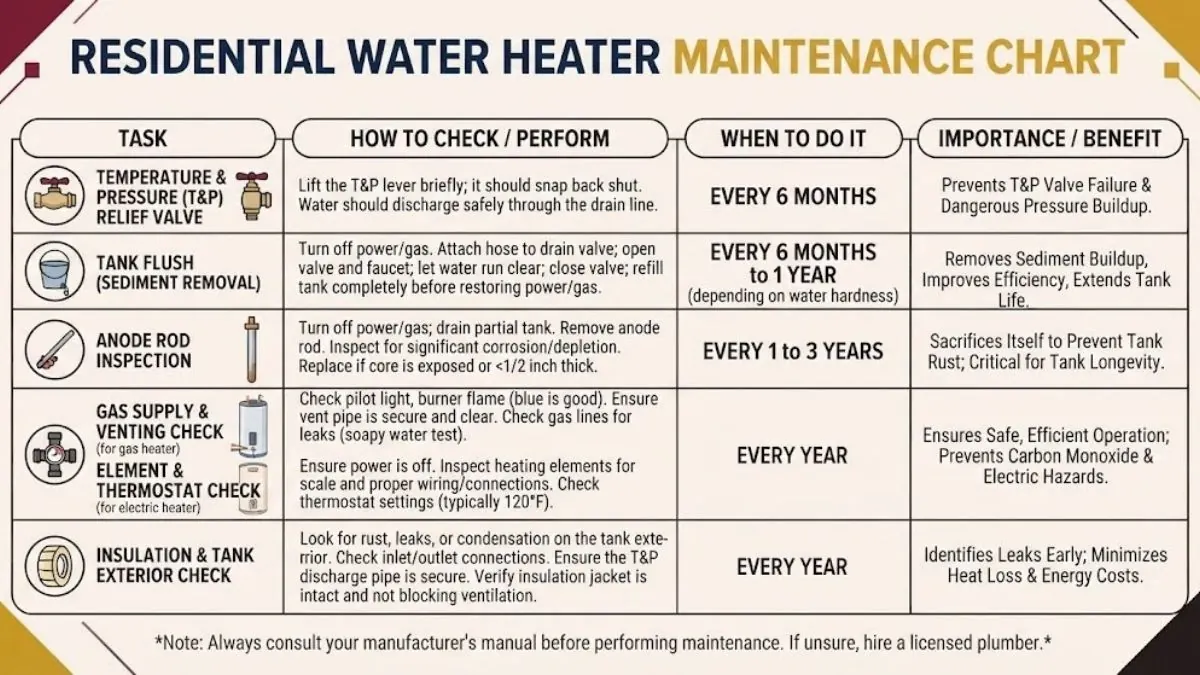
| Tankless | Descale the heat exchanger, clean the inlet screen | Inspect the vent and condensate drain |
| Heat pump tank | Flush, clean the air filter | Check the condensate drain |
The surprise for many tankless owners is the yearly flush. It takes about an hour and some descaling solution, and skipping it in hard water is the main way to shorten the life of the unit. A tank needs a flush too, but a missed tank flush is more forgiving than a missed tankless flush.
When you compare quotes, ask about maintenance as well as price. A unit that costs more and needs more care may not be the better value for a household that will not do the upkeep.
Common regrets, and how to avoid them
- 1Choosing a tankless unit without checking the gas line.
- 2Buying a tank too small for the household.
- 3Skipping the permit and bracing.
- 4Not asking about venting and clearance.
- 5Forgetting maintenance costs when comparing prices.
There is no wrong answer if the choice matches your household. A good installer will ask about hot water use, gas supply, space, and budget before recommending anything, and will tell you if the unit you prefer is a poor fit.
How the choice plays out
Take a family of five in a 1950s house with a standard tank in the garage. They run laundry, dishes, and showers back to back in the morning, and the tank runs out. A larger tank or a second unit may fix it for less than a tankless conversion that needs a new gas line. A tankless unit makes sense if they also want to free the floor space.
Now take a couple in a small house with a tank in a tight closet. They use little hot water, so a tankless unit would save modestly on gas, and a wall-mounted unit would free the closet. The deciding factor is whether the gas line and vent route work, which a plumber can confirm in one visit.
In both cases the answer came from the house, not from a general rule. That is the point of the questions earlier in this article, and it is why we ask them before we quote.
Common questions
Many are rated for around 20 years with maintenance, and a tank is more often 8 to 12. In hard water, a tankless unit that is never descaled can fail early. The yearly flush is what delivers the long life.
Often, because it does not keep a tank of water hot all day. The savings depend on how much hot water you use. Heavy users may see less benefit. Ask for an estimate based on your household.
Often, yes. Tankless units draw a lot of gas for a short time, and an older gas line may be too small. A load check comes first.
They move heat instead of making it, so they use far less electricity than standard electric tanks. They need open air space and a drain for condensate. Rebates change, so check current programs.
Choosing a new water heater?
Call the Downey line and we will talk through your household.
☎ Call (562) 488-9614