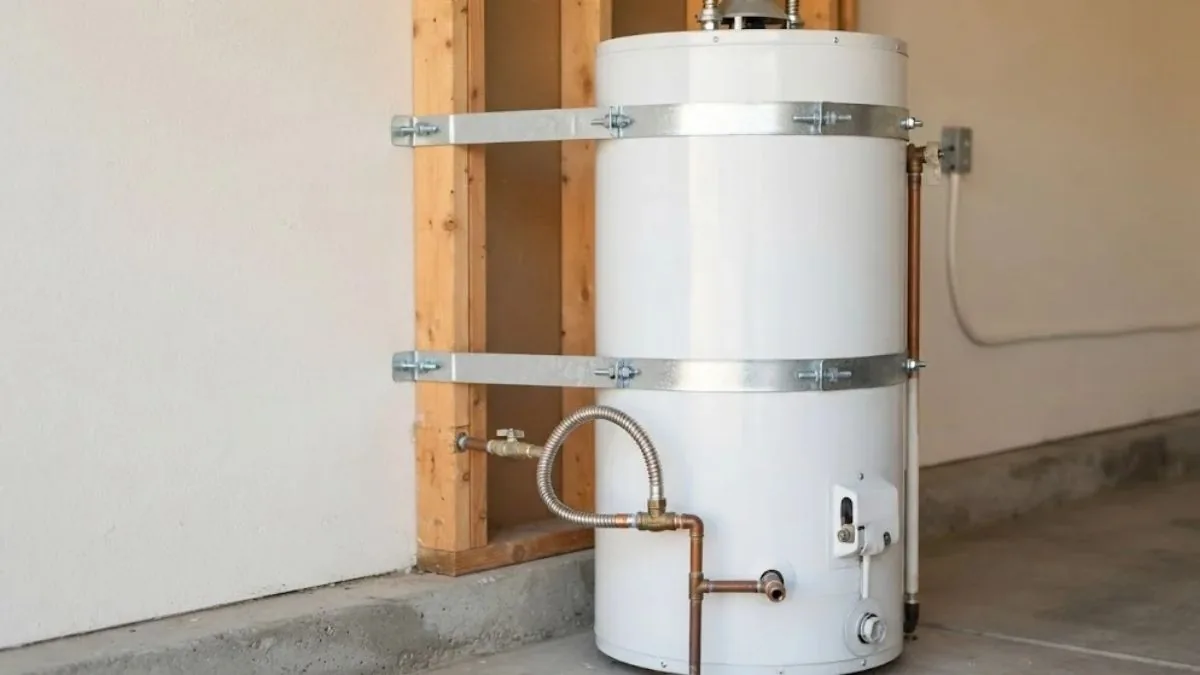
To strap a water heater in California, you anchor the tank to wall studs with two metal straps, one in the upper third of the tank and one in the lower third, each secured with lag screws into the framing. The straps stop the tank from tipping during an earthquake, which protects the gas and water lines and prevents flooding or fire. It is a one-hour job with a kit that costs little, and it is required.
If you are buying a house or replacing a heater, check that the straps are in place. A tipped tank can break its connections, and a gas leak plus a pilot flame is the combination you do not want after a quake.
Parts and tools
Gather these before you start
- 1A water heater strapping kit sized for your tank.
- 2A stud finder and a pencil.
- 3A drill and a socket set for the lag screws.
- 4A level, to mark the strap height.
- 5Gloves and safety glasses.
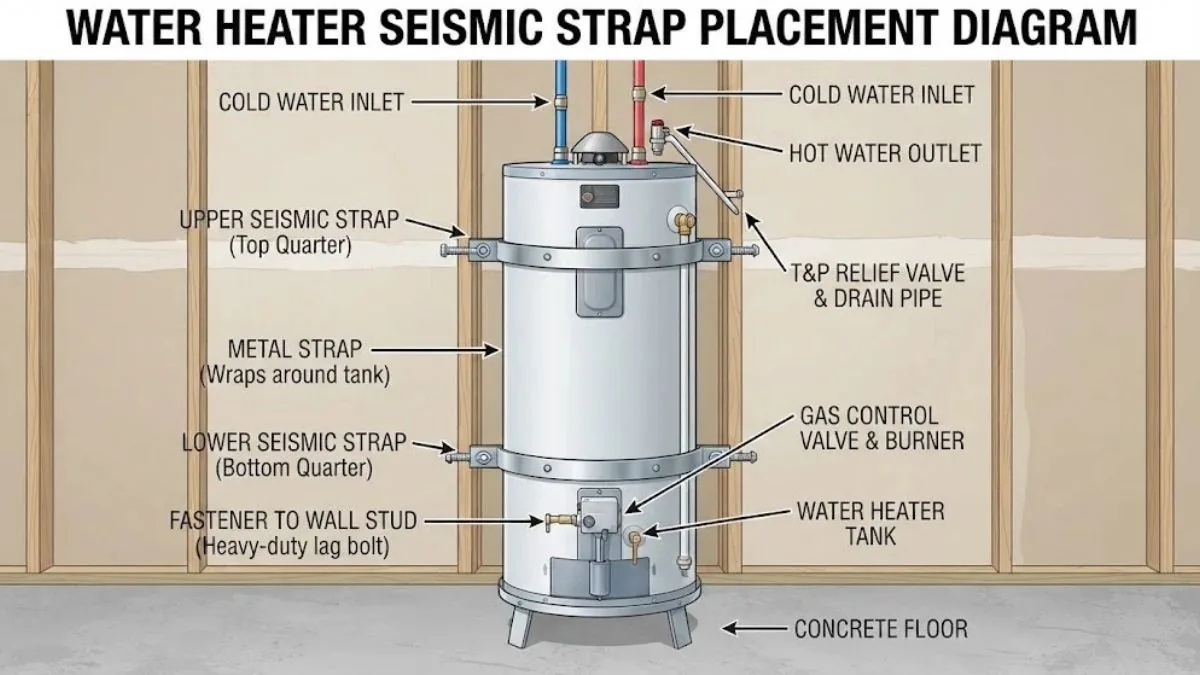
How a standard strapping job goes
Find the studs
Mark two studs behind the tank.
Mark the heights
Upper strap at the top third, lower strap at the bottom third, above the controls.
Wrap and anchor
Run the straps around the tank and lag-screw them into the studs.
Tighten and check
The tank should not move when you push it.
Setups that need a plumber
| Setup | Why it is harder | What to do |
|---|---|---|
| Masonry or block wall | No studs to anchor into | Use anchors rated for masonry, or call a plumber |
| Heater in a closet | Little room for straps | A plumber can fit a suitable kit |
| Heater on a platform | The platform must be secure | Check the platform and the straps together |
| Tall, narrow tank | Higher tipping risk | Make sure both straps are tight |
| Old rigid connectors | Pipes may tear at the fitting | Replace with flexible connectors |
Why bracing is not optional here
The California Plumbing Code, built on the Uniform Plumbing Code (UPC), expects a water heater to be braced against seismic movement. Southern California sits on active faults, and a tank that tips can tear its own lines. A gas-fired tank that falls is a fire risk, and a full tank that falls is a flood risk.
In homes built in the 1950s, which make up roughly 13,400 Downey homes by census-based counts, the heater may have been replaced several times without anyone checking the straps. A quick look takes a minute. When we replace a heater, bracing is part of the job. Our new water heater installation page explains the rest of a proper install.
A short checklist for the plumbing
What to check once the shaking stops
- 1If you smell gas or hear hissing, leave the house. Then call 911 and your gas utility from outside.
- 2Look at the water heater for leaning, leaks, or loosened connections.
- 3If water is leaking inside the house, close the main water valve.
- 4Do not relight a pilot after a quake until the gas is confirmed safe.
- 5Photograph any damage for your insurer.
If you smell gas and cannot reach a plumber, leave first and call the gas utility. Our gas line repair page explains what we do afterward. We also help homeowners in Paramount, CA with bracing and connector upgrades.
What to look for on the package
| Feature | Why it matters | Notes |
|---|---|---|
| Sized for your tank | Straps come for different tank diameters | Measure the tank width |
| Metal straps | Plastic or thin straps can fail | Look for steel straps with hardware |
| Lag screws included | Must be long enough to reach the studs | Check the length against the wall |
| Instructions with spacing | Shows heights for upper and lower straps | Follow them exactly |
| Compliance note | Lists the standard it meets | Keep the instructions |
Buy a kit, not loose parts, unless you know exactly what you need. A kit pairs the straps with the right hardware. If your tank is in a closet or on a raised platform, ask a plumber to review the setup, because the platform itself must be secure.
When you replace a heater, bracing should be part of the job. Ask the installer to show you the straps after they finish, and take a photo for your records.
A checklist when buying a home
- 1Look at the water heater and confirm two straps are in place.
- 2Push the tank gently. It should not move.
- 3Check the date on the data plate. Older than ten years suggests replacement soon.
- 4Look for flexible connectors on the gas and water lines.
- 5Ask the seller for any permit paperwork on the heater.
Bracing does not make a tank earthquake-proof, but it makes a tipped tank, a torn line, and a flood or fire far less likely. For a one-hour job, that is a good trade.
A heater in a hall closet
Picture a 1950s house where the water heater sits in a hall closet with the door removed to make room. The tank is against a drywall wall, with studs 16 inches apart behind it. The straps go into those studs, not into the drywall alone, and the lag screws need a pilot hole so they do not split the wood.
If the closet has a raised wooden platform, as some do, the platform needs to be fastened to the floor and the wall. A strap that holds a tank to a loose platform is only as strong as the platform. A plumber can check this in a few minutes and fix it while there.
The same house probably has a rigid copper or galvanized line to the heater. Swapping it for a flexible connector is inexpensive and gives the tank room to move without tearing the pipe, and it is a good job to do the same afternoon as the straps.
Common questions
Yes. California requires water heaters to be braced or anchored against earthquake movement. Check the installation instructions and the code for your tank size.
Two is typical: one in the upper third of the tank and one in the lower third, with the lower strap at least a few inches above the controls. A kit lists the exact spacing.
Many people do, if the heater is against a stud wall and you can find the studs. If the wall is masonry or the heater is in a closet or on a platform, a plumber should check the setup.
Flexible water and gas connectors absorb movement better than rigid pipe, which can tear at the fitting. A plumber can swap connectors while on site.
Heater needs bracing or replacing?
Call the Downey line and we will check the setup.
☎ Call (562) 488-9614