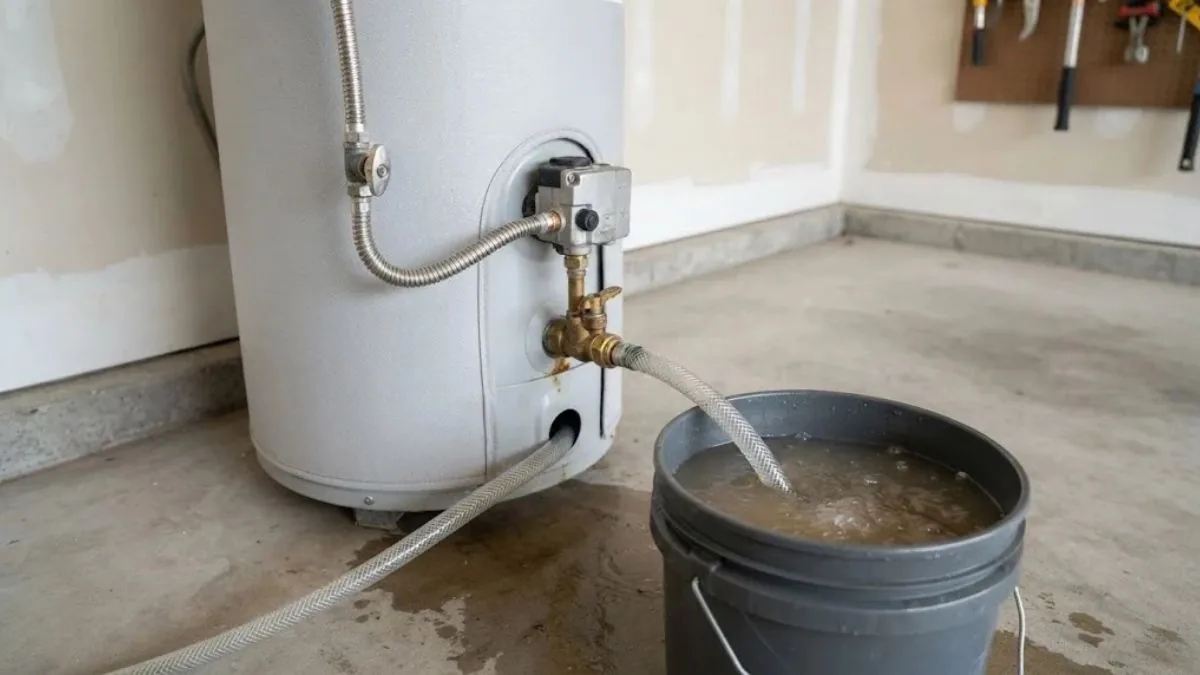
To flush a tank water heater, turn off the power or gas, close the cold water valve, attach a hose to the drain valve at the bottom, open a hot tap in the house, and drain the tank until the water runs clear. Then close the drain, refill the tank, and restore power. It takes about an hour, and in hard-water areas like ours it is one of the most useful bits of maintenance a homeowner can do.
The reason is sediment. Minerals in hard water settle on the bottom of the tank, insulate the water from the burner or lower element, and use up the anode rod that protects the steel. Flushing sweeps some of that out before it hardens into a layer you cannot remove.
What you need and what to check
A short checklist
- 1A garden hose long enough to reach a floor drain or the yard.
- 2Work gloves. The water can be very hot.
- 3A flathead screwdriver or a bucket, in case the drain valve is slow.
- 4The tank's age on the data plate. Past about ten years, consider calling a plumber.
- 5Time. Do not rush a hot tank.
How to flush the tank
Power off
Switch off the breaker for electric, or set gas to pilot or off.
Water off
Close the cold supply valve on top of the tank.
Connect and open
Run a hose from the drain valve and open a hot tap.
Drain and rinse
Drain the tank, then briefly open the cold supply to stir the sediment.
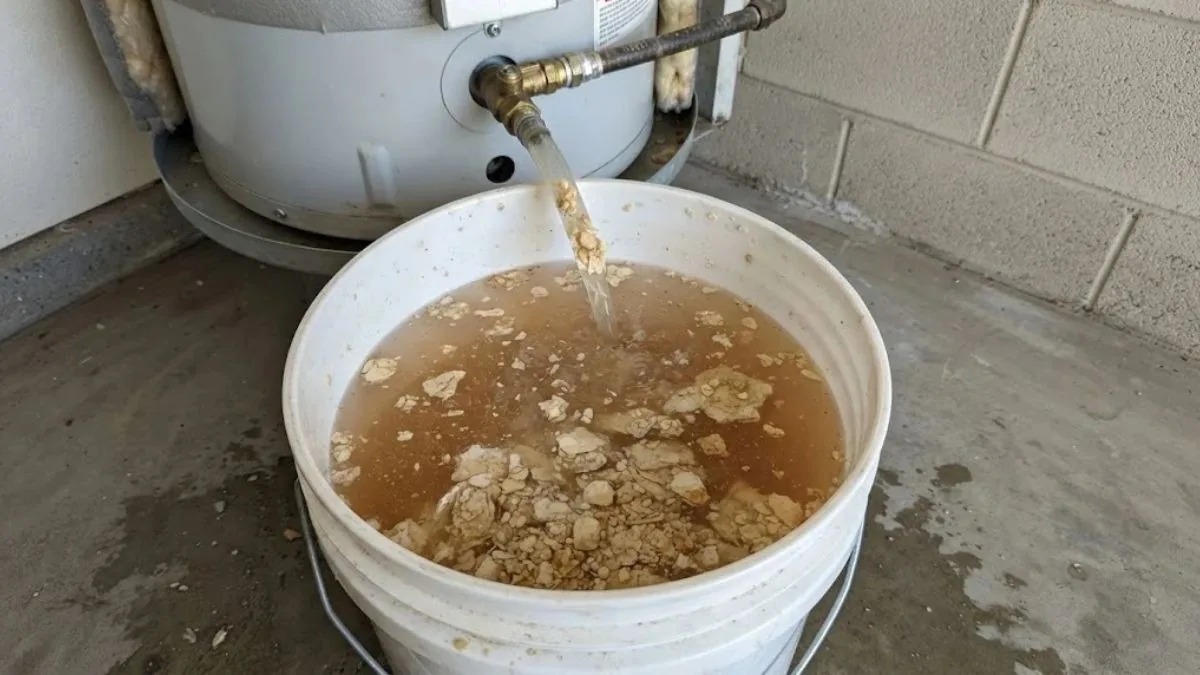
Keep draining until the water from the hose runs clear. Close the drain valve, remove the hose, and close the hot tap you opened. Open the cold supply and let the tank fill.
Leave a hot tap open until water flows steadily, which shows the tank is full. Only then restore power or relight gas according to the label. Turning on an electric element in an empty tank burns it out.
Problems you may hit
| Problem | Likely cause | What to do |
|---|---|---|
| Water barely drains | Drain valve clogged with sediment | Open the cold supply briefly to stir it, or call a plumber |
| Drain valve will not close | Debris in the seat | Open and close it a few times, or replace it |
| Valve leaks after you close it | Worn seat or brittle plastic | Replace the valve |
| Very little sediment | Recent flush or low-sediment water | Fine, repeat yearly |
| Large chunks come out | Years of buildup | Consider replacement soon |
Why flushing matters here
Golden State Water's 2026 report for the Norwalk System lists 2025 hardness of 8.0 to 30 grains per gallon, with an average of 18. The City of South Gate's 2021 report puts its average near 13. These are hard-water numbers, and a tank in water like that collects sediment faster than one in a soft-water city.
Downey's own supply is hard as well, and the city's current report is the place to confirm the exact figure. Whatever the number, the routine is the same. Flush once a year, check the anode rod every few years, and replace a tank that is past its prime.
Our water heater repairs page explains how to tell a repair from a replacement, and the water softener installation and repair page covers treating scale at the source. We work on water heaters in Norwalk, CA as well.
When to leave it to a plumber
Call a plumber if the tank is leaking, if the drain valve is plastic and old, if the heater is in an attic or tight closet, or if you smell gas. A flush is a maintenance task, not a repair. If the tank is rusting at the base or dripping from the body, flushing will not fix it.
Also check that the heater is strapped to the wall. California requires bracing against earthquakes, and a plumber can add straps while on site.
What changes between the two types
| Step | Gas tank | Electric tank |
|---|---|---|
| Power | Set the control to pilot or off | Turn off the breaker |
| Refill caution | Do not relight until the tank is full | Do not switch the breaker on until the tank is full |
| Sediment sits | Between the burner and the water | Around the lower element |
| What fails from sediment | Burner efficiency drops, bottom overheats | Lower element burns out |
| Extra check | Venting and flame color | Element continuity, by a pro |
A small part with a big job
The anode rod is a sacrificial metal rod that corrodes so the steel tank does not. In hard water it wears faster. To check it, shut off the power and water, drain a few gallons, and use a socket wrench to unscrew the hex head on top of the heater.
A rod that is mostly bare steel wire needs replacing. Replacing it can extend the life of a tank by years.
Some tanks have limited clearance above them, and the rod needs room to pull out. In that case a plumber can fit a flexible rod. Plan the check every three years, or sooner in very hard water.
Signs your tank is past flushing
- 1Rusty water from the hot tap only.
- 2Moisture or rust around the base.
- 3A tank over ten years old with loud rumbling.
- 4Repeated pilot or element failures.
- 5Hot water that runs out far faster than it used to.
When the signs add up, a flush buys a little time and a replacement buys certainty. A tank that fails on its own schedule usually fails at the worst moment, and the water that comes out of it stays in your house.
Common questions
Once a year is a common recommendation, and in hard water it is worth doing. Water that is very hard builds sediment faster. If you have never flushed an older tank, the sediment may be thick and the drain valve may clog.
Usually, but an old plastic drain valve can crack when turned. If yours looks brittle, or if the tank is past ten years, a plumber can flush it and replace the valve. Always let the water cool and wear gloves.
Often. The popping is steam bubbles forcing through a layer of sediment. Flushing removes some of it. If the noise returns right away, the sediment layer is thick or the tank is worn.
The anode rod is a sacrificial metal rod that protects the steel tank from rusting. In hard water it wears faster. Checking it every few years can add life to the tank, and it needs a socket wrench and some room above the heater.
Tank misbehaving?
Call the Downey line and we will tell you whether to repair or replace.
☎ Call (562) 488-9614