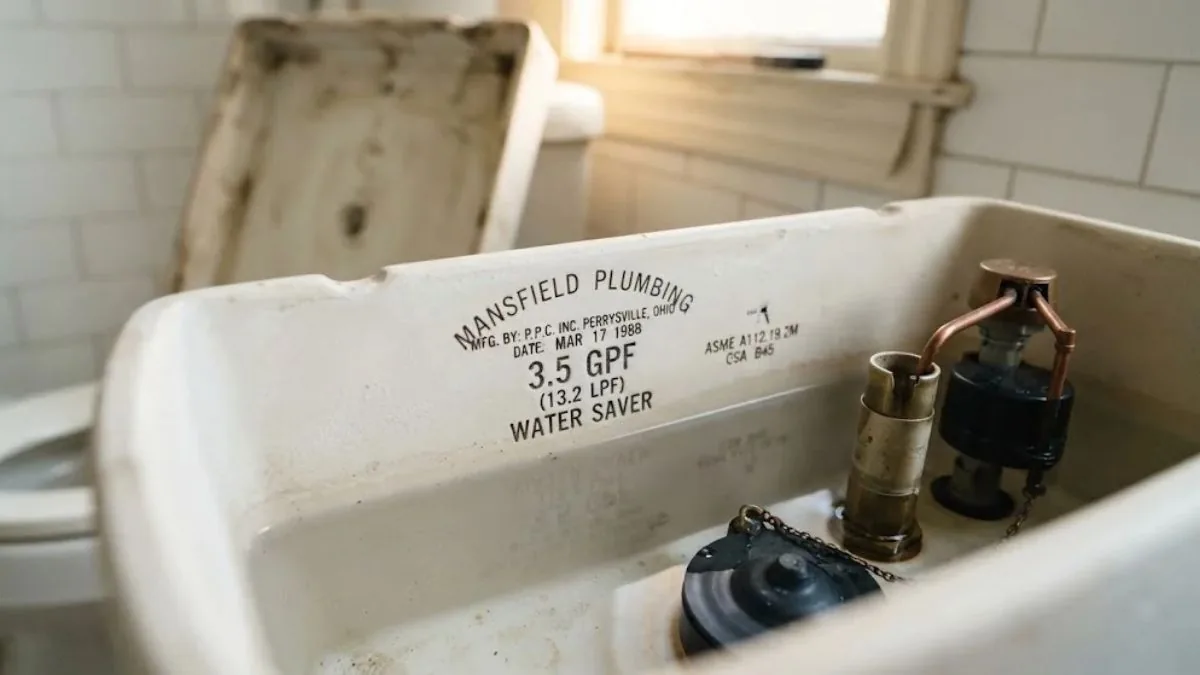
California's SB 407 requires water-conserving plumbing fixtures in homes and other buildings built before 1994. The law is generally described as targeting toilets that use more than 1.6 gallons per flush, showerheads above 2.5 gallons per minute, and faucets above 2.2 gallons per minute, and it comes up most often when a home is sold. The short version for an owner of an older house: check your fixtures before you list the house, not after the buyer's inspector does.
This article is general information, not legal advice. Confirm how the law applies to your transaction with your real estate agent or an attorney.
Fixture limits at a glance
| Fixture | Older fixtures may use | The limit generally cited |
|---|---|---|
| Toilet | 3.5 gallons per flush or more | 1.6 gallons per flush |
| Showerhead | 2.5 to 5 gallons per minute | 2.5 gallons per minute |
| Bathroom and kitchen faucet | More than 2.2 gallons per minute | 2.2 gallons per minute |
| Urinal | More than 1 gallon per flush | 1 gallon per flush |
These are the limits used in SB 407 summaries. Current California rules for new fixtures are tighter, with 1.28 gallons per flush for toilets and 1.8 gallons per minute for showerheads. If you are replacing a fixture anyway, buy one that meets the current limit and it will satisfy the older rule too.
Most local homes are covered
Census-based counts put roughly 13,400 of Downey's 36,000 or so homes in the 1950s, with about 3,000 more in the 1940s and about 5,800 in the 1960s. Together those decades account for most of the housing. Nearby, South Gate has about 5,600 homes from 1939 or earlier and Norwalk has a spread across decades. A 1950s house may have had its bathroom updated since, or it may still have its original toilet.
The practical step is an inventory. Walk through the house and note every toilet, showerhead, and faucet, and check each for a flow rating. Replace the ones that fail.
Many are inexpensive, and a new toilet is the biggest item. Our toilet replacement page covers when replacement makes sense.
A simple pre-listing checklist
- 1Look inside each toilet tank for a stamped flush rating, and replace any above 1.6 gallons.
- 2Check each showerhead for a flow rating, and swap any above 2.5 gallons per minute.
- 3Unscrew faucet aerators and look for a flow rating, or replace them.
- 4Keep the receipts and a list of what you replaced.
- 5Ask your agent how the disclosure applies.
Which items are DIY and which are not
Showerheads and aerators are a screwdriver job. Toilets are a bigger project, because a new toilet needs a proper seal and a level setting, and an old flange can complicate things. Shower valves and tubs are plumber work. If you are replacing a whole shower, our shower installation page explains what the valve and drain should meet.
If you are selling a rental in Pico Rivera, CA, Paramount, or South Gate, the same logic applies. Do the inventory first, and spread the work over time so the sale is not held up.
How this tends to play out in a sale
Sellers of older homes are generally expected to disclose whether a property has non-compliant plumbing fixtures, and compliance may be tied to the sale. Buyers' inspectors often note toilets and showerheads. The easiest approach is to check early so nothing surprises you at the end of escrow. Your agent can explain the paperwork for your transaction.
None of this is a reason for panic. Many older homes have already had fixtures replaced, and the rest can usually be brought into line quickly and inexpensively. Toilets are the biggest single item, and showerheads and aerators are minor.
| Order of work | Item | Why this order |
|---|---|---|
| First | Showerheads and faucet aerators | Low cost, quick, and easy to prove |
| Second | Toilets with a high flush rating | Largest water savings and most visible |
| Third | Anything damaged or leaking | Fix before the buyer's inspection |
| Last | Cosmetic updates | Optional, not part of the rule |
Questions to ask your agent
- 1How does the disclosure apply to my property type?
- 2Do I need to fix fixtures before closing, or only to disclose?
- 3What proof should I keep, such as receipts and photos?
- 4Does a lender or buyer ask for compliance documents?
- 5Does a rental unit have different timing?
If a toilet is older than the law itself, replacing it is the sensible choice. If you are unsure whether one meets the limit, a plumber can read the stamped rating or measure the flush volume in a few minutes.
Rentals and the same fixtures
Owners of rental property should assume the same fixture rules matter for them. A rental built before 1994 with original toilets and showerheads is a candidate for the same inventory. Tenants often do not know what their fixtures use, and a short walkthrough at turnover is the easiest time to check.
In Paramount and South Gate, where renters are the majority of households by census-based figures, many owners of small buildings handle this fixture by fixture over time. Keeping a simple list, with the date and the model of each replacement, makes it easy to show what has been done.
| Record to keep | Why |
|---|---|
| Photo of the old fixture's rating | Shows what it was |
| Receipt for the new fixture | Shows what replaced it |
| Date of replacement | Establishes the timeline |
| Installer's note, if a plumber did the work | Supports compliance |
A practical note for owners who plan to stay put: the same fixtures that matter at sale also affect your water bill every month. A pre-1994 toilet can use two or three times the water of a current one per flush, and a household of four flushes many times a day. Swapping fixtures is among the quickest ways to cut water use at home, so the rule's goal and your own are aligned.
New fixtures are held to tighter limits than the ones SB 407 targets, and the California Plumbing Code, built on the Uniform Plumbing Code (UPC), sets the rules for how they are installed. A replacement that meets the current limits and is installed to code will satisfy the older rule as well, which is the simplest way to stay ahead of a buyer's inspection.
Common questions
California's SB 407 requires water-conserving plumbing fixtures in buildings built before 1994. The law is generally described as covering toilets over 1.6 gallons per flush, showerheads over 2.5 gallons per minute, and bathroom and kitchen faucets over 2.2 gallons per minute. This is a general summary, so confirm the details with your agent or the Civil Code.
At sale or transfer, and sellers are expected to disclose whether a property has non-compliant fixtures. It can also come up when you remodel. Ask your real estate agent how it applies to your transaction.
Probably, if the house was built before 1994. By census-based counts, most Downey homes were built before then, with the largest group in the 1950s. The fixtures may have been replaced already, and that is what to check.
Toilets usually have the flush rating stamped inside the tank or on the bowl. Showerheads and faucets often show a flow rating on the head or the aerator. If a label is missing, a plumber can measure it.
Need fixtures replaced?
Call the Downey line and we will help you plan the work.
☎ Call (562) 488-9614